
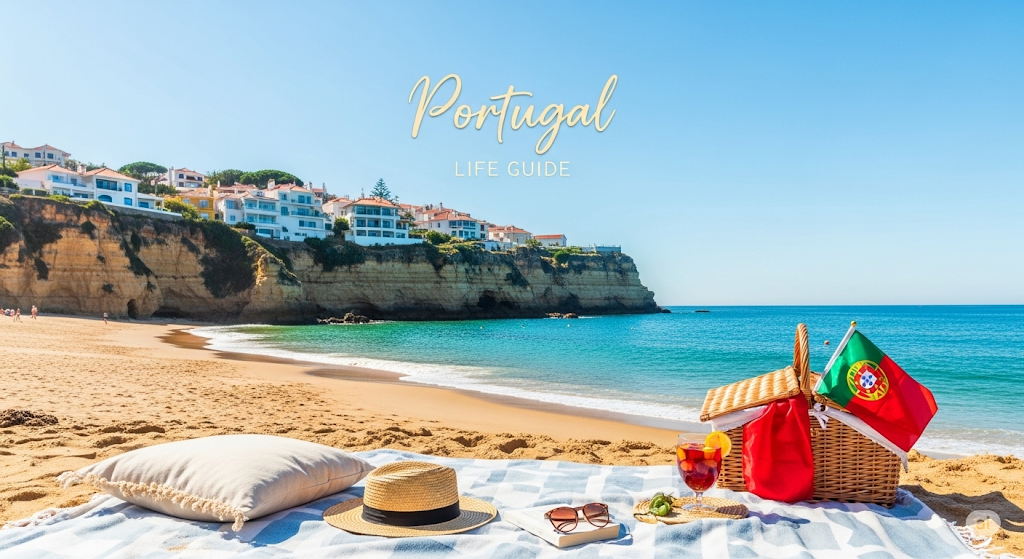
A New Life in Portugal: A Comprehensive Guide for 2025
Introduction: The Call of the Golden Light
The fresh scent of the Atlantic, the melancholic tones of Fado drifting from the cobbled slopes of Lisbon, and the promise of that famous slow, more meaningful pace of life offered by the golden beaches of the Algarve… In recent years, Portugal has become an “expat magnet,” attracting people from all over the world in search of a new life.¹ The charm of this Western European country is not just about its promise of over 300 sunny days a year or its tables laden with fresh seafood; it also appeals to a desire for a calmer, safer, and more community-focused existence.³
However, beyond the glittering Instagram photos and enthusiastic blog posts lies the reality of moving to Portugal. This guide is designed to illuminate that reality. Its purpose is to build a bridge between dreams and concrete data, honestly presenting the opportunities and inevitable challenges that come with the decision to settle in Portugal. Prepared with up-to-date data as of 2025, this comprehensive analysis will shed light on every step of a potential immigrant’s journey, starting from the “Why?” question, to the “How?” and most importantly, delving into life in Portugal in all its aspects, including “At what cost?”

Chapter 1: The Portuguese Charm: Quality of Life and Daily Life
The elements that define Portugal’s quality of life are hidden in the country’s geography, social fabric, and the rhythm of daily life. These factors form the cornerstones that make the country so attractive to foreigners.
A Canvas Touched by the Sun: Climate and Geography
One of Portugal’s most prominent attractions is undoubtedly its Mediterranean climate. The fact that the country sees more than 300 sunny days a year encourages time spent outdoors and an active lifestyle.¹ However, this general picture shows significant regional differences.
Cities in the north, like Porto and Braga, have a cooler and wetter climate, which turns the region into a geography adorned with lush green valleys and fertile lands.⁶ The central region, including the capital Lisbon and the Silver Coast, offers mild winters and hot, dry summers.⁹ The southern Algarve region, with its drier climate, is a paradise especially for retirees and holidaymakers, thanks to its stable temperatures and abundant sunshine throughout the year.⁷ The island of Madeira in the middle of the Atlantic offers a completely different experience with its unique subtropical microclimate, known as the “island of eternal spring.”¹⁴ This climatic diversity allows every individual to find their ideal living environment.
However, this idealized climate has another side. In the summer months, especially in the interior and the south, temperatures can sometimes exceed +40°C, reaching sweltering levels.¹ Winters, especially in the north, can be persistently rainy and windy.⁹ This situation, combined with the inadequacies of the country’s housing infrastructure, can turn into an unexpected comfort problem. Most buildings in Portugal, especially older ones, lack central heating or an effective insulation system.⁴ This leads to houses being “cold as a refrigerator” and damp in the winter months.¹⁹ Consequently, despite the mild weather outside, it is a common occurrence to face unexpectedly high electricity bills due to portable heaters used to stay warm indoors.²⁰ Therefore, for someone considering a move to Portugal, it is a fundamental quality of life and budget management decision to carefully evaluate not only the weather but also the age, insulation quality, and heating system of the chosen residence.
Peace and Security: For Those Seeking a Haven
One of Portugal’s most globally prominent features is its high level of safety. According to the 2024 and 2025 Global Peace Index, the country is ranked as the 7th safest country in the world.⁴ This statistic is a significant draw, especially for families with children, retirees, or professionals seeking a more peaceful environment.² General crime rates are low, and violent crimes are rare.²⁷ The general attitude of the local population towards foreigners is described as warm, kind, and hospitable, which facilitates the integration of newcomers into the community.¹
Despite this high perception of security, it is important to maintain a realistic perspective. Petty crimes such as pickpocketing, snatch-and-grabs, and bag theft are quite common, especially in large tourist centers like Lisbon and Porto.⁴ Thieves often target tourists and inattentive foreigners. Crowded public spaces, popular tourist spots, hotel lobbies, and public transport—especially Lisbon’s famous tram lines 15 and 28 are places where such incidents frequently occur.³⁰ Therefore, while enjoying the general tranquility of Portugal, it is wise to be mindful of the security of personal belongings and to remain vigilant, particularly in busy areas.
The Rhythm of Life: The Beauty and Challenges of Slowness
Portugal is often identified with a “laid-back lifestyle.”¹ This is one of the country’s greatest promises for those seeking a more balanced work-life arrangement. In Portuguese culture, ample time is dedicated to lunch, family ties and community spirit are strong, and people are more focused on living in the moment.³⁴ This slow rhythm is seen as an element that reduces stress and enhances the quality of life.
However, there is another side to the coin. For those coming from cultures accustomed to efficiency and punctuality, this slow pace can sometimes be a source of frustration. Being late for appointments or social gatherings may be considered normal, restaurants and shops may close for a few hours for a “siesta” in the afternoon, and many businesses may be completely closed on Sundays.¹ This “no rush” mentality also manifests itself in the country’s notorious bureaucracy, causing official procedures to take much longer than expected.
In the Lap of Nature: Beaches, Parks, and Activities
Portugal’s geographical richness offers its residents a wide variety of leisure activities. The country’s coastline, stretching for about 800 kilometers along the Atlantic, is home to some of the world’s most beautiful beaches. Beaches like Praia da Falésia in the Algarve region have won international awards.²⁴ Surfing is almost a part of Portugal’s national identity. From the giant waves of Nazaré to the world surf reserve in Ericeira and the windy shores of Sagres, the country is a paradise for surfers of all levels.¹
Natural beauty is not limited to the coastline. The granite peaks and lush green valleys of Peneda-Gerês National Park in the north, the terraced vineyards of the Douro Valley, and the fairy-tale forests of the Sintra-Cascais Natural Park offer endless exploration opportunities for nature lovers.²⁴ This rich geography allows for a wide range of activities such as hiking, mountain biking, golf, sailing, canyoning, and paragliding.²⁴

Chapter 2: The Financial Compass: Understanding the Cost of Living
One of the most critical factors in the decision to move to Portugal is an accurate analysis of the cost of living. Although the country generally offers an affordable life, this situation varies significantly depending on the source of income and the city of residence.
General Overview: One of Western Europe’s Most Affordable Countries
Portugal is renowned for having one of the lowest costs of living in Western Europe.⁵ The overall cost of living is approximately 37-40% lower than in the United States, 43% lower than in the United Kingdom, and 5.3% lower than in neighboring Spain.² This affordability is felt in many areas of life, from grocery shopping and dining out to public transport and accommodation.²³ For example, a two-person dinner at a mid-range restaurant costs about €40, and the “prato do dia” (dish of the day) option offered in many restaurants is ideal for a budget-friendly meal.¹⁷
Monthly Budget Scenarios (2025 Estimates)
The cost of living varies greatly depending on the chosen city and lifestyle. While a single person can live comfortably on about €1,200–€1,500 per month in smaller towns or rural areas⁴, this figure can rise to the €2,000–€2,500 range in a large, popular city like Lisbon.²³ A comfortable standard of living for a couple is estimated at around €2,300–€2,750 ($2,500–$3,000) per month outside the major cities.⁴⁷ The monthly expenses for a family of four would be around €2,600, excluding rent.⁴⁴
To make these abstract figures more concrete, an estimated monthly budget for a couple living outside major metropolises like Lisbon or Porto is presented in the table below. This table offers a starting point for potential immigrants to assess their own financial situation.
Note: This table is an estimate based on data from source 4 and may vary according to personal spending habits.
Cities Under the Microscope: A Cost Comparison
The cost of living within Portugal is not homogeneous. The capital, Lisbon, is by far the most expensive city.¹⁷ It is followed by the country’s second-largest city, Porto, the affluent coastal town of Cascais, and the touristy Algarve region.¹⁷ For those seeking a more affordable life, cities in the north and center like Braga, Coimbra, and Aveiro, as well as inland settlements like Castelo Branco, offer attractive alternatives.⁴
This difference is most evident in rental prices. While the average rent for a one-bedroom apartment in Lisbon’s city center ranges from €1,200–€1,400, this figure drops to €850–€1,050 in Porto and to the €900–€1,000 range in the Algarve’s central city, Faro.⁴³ Similarly, the cost of dining out also varies from city to city. A one-person meal at a budget-friendly restaurant in Lisbon costs about €14, while in Porto this cost is €10.⁵¹
The table below compares the basic living costs in the three most popular regions for expats: Lisbon, Porto, and the Algarve (centered on Faro). This is a critical financial breakdown that directly affects the answer to the question, “Where should I settle?”
Note: This table is based on average data for 2025 from source 43.
The Realities of the Housing Market
Understanding the dynamics of the housing market is vital when evaluating Portugal’s “affordable” image. The increasing demand from foreign investors, tourists, and digital nomads has significantly driven up property prices and rents in recent years, especially in popular areas like Lisbon, Porto, and the Algarve.¹⁴ This has led to serious competition in the market.
However, one of the biggest challenges is the quality of the country’s housing stock. A significant portion of buildings in Portugal are between 40 and 200 years old.¹⁹ While these historic buildings may be aesthetically pleasing, they can have serious shortcomings in terms of modern living standards. As mentioned earlier, problems such as the lack of central heating, dampness and mold issues due to poor insulation, and limited electrical infrastructure that doesn’t allow for running multiple high-power appliances simultaneously are quite common.⁴
This situation creates a paradox about who Portugal is truly “cheap” for. While the country’s low cost of living is often mentioned, local salaries are also well below Western European standards. In a country where the average net salary is around €1,200 as of 2025⁴, the fact that average rent in a city like Lisbon reaches €1,300–€1,500¹⁹ shows how challenging it can be to get by on a local income. Therefore, Portugal’s affordability is a relative concept that largely depends on the source of income. The country can be a financial haven for remote workers who bring their income from abroad (in stronger currencies), retirees with passive income, or investors coming with their savings. However, for a foreigner planning to enter the Portuguese job market and live on a local salary, especially in big cities, the country is not cheap at all. This is a critical distinction that shows a potential immigrant must realistically align their career plan with their budget expectations.
Chapter 3: The Moving Process: Visas, Residence Permits, and Bureaucracy
The legal framework for starting a new life in Portugal consists of visa and residence permit procedures. This process requires careful planning and patience with the country’s famous bureaucracy.
Gateways to Portugal: Visa Options
Citizens of countries outside the European Union (EU) who plan to stay in Portugal for more than 90 days must apply for a national visa (D-type visa).⁵⁶ Different types of visas are available depending on the applicant’s situation. The most popular options are:
- D7 Visa (Passive Income Visa): This visa is designed for individuals with a regular and stable passive income. Pensions, rental income, dividends, or income from investments fall into this category. As of 2025, the minimum monthly passive income required for a single applicant is Portugal’s national minimum wage, which is €870.⁴ For a spouse included in the application, 50% of this amount (€435) is added, and for each dependent child, 30% (€261) is added.⁵⁸ Applicants are also expected to show savings in a Portuguese bank account that can cover at least one year’s living expenses (approximately €10,440 for a single person).⁵⁹
- D8 Visa (Digital Nomad Visa): This was created for remote workers employed by a company outside Portugal or freelancers serving international clients. The main requirement for this visa is to prove a monthly income of at least four times the Portuguese national minimum wage. As of 2025, this figure is approximately €3,480.⁶²
- Golden Visa (Investor Visa): This program grants residence permits to individuals and their families who make a specific amount of investment in Portugal. The minimum investment amount starts at €250,000 for donations to cultural heritage preservation or artistic production projects. For participation in investment funds, one of the most common options, a minimum investment of €500,000 is required.⁴ An important change: With the legal amendment made on October 7, 2023, real estate acquisition has been removed as a valid investment option for the Golden Visa program.⁴
In addition, there are other pathways such as work visas (D1/D3) for those with a job offer from a Portuguese employer, student visas (D4/D5), and family reunification visas (D6) for the family of someone legally residing in Portugal.⁵⁶
The following table compares the two most popular visa types, D7 and D8, to help applicants determine the most suitable path for their situation.
Note: This table is based on information from source 58.
The Path from Visa to Residence Permit
The process of settling in Portugal is a two-stage process. First, a national visa (D-type) is obtained from the Portuguese consulate in one’s home country. This visa is usually valid for four months and grants the holder the right to legally enter Portugal and apply for a residence permit.²³
The next step after entering Portugal is to get an appointment with AIMA (Agência para a Integração, Migrações e Asilo – formerly SEF).²³ At this appointment, biometric data such as fingerprints are given, and the application for a temporary residence permit (Autorização de Residência) is completed. This temporary residence permit card is usually issued for an initial period of two years and can then be renewed for a three-year period.⁵⁸
A person who has legally resided in Portugal for a total of five years acquires the right to apply for a permanent residence permit or Portuguese citizenship at the end of this period.⁴ For a citizenship application, in addition to the five-year legal residence requirement, additional conditions must be met, such as having a basic level (A2) of Portuguese language proficiency and presenting a clean criminal record.⁵⁶
The Bureaucracy Labyrinth: Portugal’s Famous Challenge
Portugal’s slow, complex, and sometimes inefficient bureaucracy is one of the most frequently cited complaints by foreigners who settle in the country.³ Official procedures such as visa applications, residence permit renewals, obtaining a tax number (NIF), opening a bank account, or registering an address can take much longer than expected and require considerable patience. It is a common situation for different government departments to provide conflicting or incomplete information on the same matter, which further complicates the process.²⁰
One of the main reasons for this situation is that the processes and systems are not designed with foreigners in mind. This structural difficulty, combined with the language barrier, can make a simple task seem daunting.⁴ For this reason, many expats prefer to get professional help from a local lawyer, accountant, or a specialized consulting firm to manage these processes. Although this creates an additional cost, it is often seen as a wise investment to minimize potential time loss, stress, and errors.²⁰
In fact, this bureaucratic slowness stems from the same cultural root as the relaxed pace of life, one of the country’s most attractive features. The general philosophy of “no rush” and “letting things take their course” throughout Portugal also causes the bureaucratic wheels to turn slowly. From this perspective, a foreigner’s struggle with bureaucracy actually serves as a kind of “cultural adaptation test.” If a person cannot tolerate the uncertainty and slowness created by waiting months for an official document or the difficulty of getting an appointment, they will likely also have trouble adapting to the general rhythm of life in Portugal. Therefore, a potential immigrant should look at bureaucracy not just as an annoying obstacle to overcome, but also as an opportunity to experience a fundamental feature of Portuguese culture firsthand and to understand whether this lifestyle is truly suitable for them.
Chapter 4: Career, Welfare, and the Tax System
The main pillars of building a sustainable life in Portugal are understanding the dynamics of the job market, the functioning of the healthcare system, and tax obligations. These areas are the most important factors that directly affect the quality of life the country offers.
The Portuguese Job Market: Opportunities and Realities
Although the Portuguese economy has shown steady growth in recent years, the job market has its own unique dynamics. As of 2025, the unemployment rate is around 6%; while this represents an improvement over previous years, it is still slightly higher than some other EU countries.⁷¹
However, there is a significant demand for labor in certain sectors. Information Technology (IT), tourism and hospitality, healthcare services, business support centers offering multilingual customer service, renewable energy, and construction are the areas that offer the most opportunities for foreigners.⁷⁴ The capital, Lisbon, and the country’s second-largest city, Porto, are emerging as Europe’s rising tech and startup hubs, offering an attractive environment for skilled professionals in these fields.⁸⁰
However, the reality of salaries in Portugal is one of the most critical issues for those considering a move. Salaries are generally well below the Western European average.² As of 2025, the national minimum wage is set at €870 per month, based on 14 salary payments per year. The average net salary is around €1,200.¹⁷ Although salaries in high-skilled IT positions like software development can exceed €2,900 per month⁸⁵, the general trend is that salaries are lagging behind the rising cost of living, especially in big cities.¹⁹
Finding a Job as a Foreigner
For non-EU citizens, the process of finding a job in Portugal usually begins before coming to the country. In most cases, to apply for a work visa, one must have a valid job offer from an employer in Portugal.⁵⁷ Employers may need to prove that they were unable to fill the relevant position with a candidate from Portugal or another EU country first.⁸⁸
An exception to this is the Job Seeker Visa program. This visa allows a person to come to Portugal without a prior job offer and actively look for work for 120 days (extendable for another 60 days). If a job is found during this period, the person can apply for a residence permit from within the country.⁹⁰
Language is a decisive factor in the job search process. While English may be sufficient in sectors like tourism and international technology companies¹, knowing Portuguese is generally a requirement for working in local companies and public services.⁴ Learning the language is of critical importance for professional integration and career development. Online portals like LinkedIn, Indeed, Sapo Emprego, and the European Job Mobility Portal EURES are widely used in the job search process.⁹²
The Tax System and Changes to the NHR Program
Portugal’s standard income tax system has a progressive structure based on income, with the highest tax bracket reaching up to 48%.⁹⁵ However, for many years, the country has offered special tax regimes to attract foreigners.
The most famous of these regimes, the Non-Habitual Resident (NHR) program, underwent a significant change as of 2024. This popular program, which offered foreigners great advantages such as tax exemption on most foreign-sourced income and a flat tax rate of 20% on certain Portuguese-sourced income for 10 years, was completely closed to new applications as of March 31, 2025.⁹⁷
In place of NHR, a much narrower new incentive program known as IFICI (Tax Incentive for Scientific Research and Innovation) has been introduced.⁹⁶ This new regime, also referred to as “NHR 2.0,” only targets professionals, researchers, and academics working in “high value-added” fields that Portugal has strategically prioritized, such as scientific research, technology, innovation, startups, and higher education. These individuals will continue to benefit from a flat tax rate of 20% on their Portuguese-sourced professional income and an exemption on certain foreign incomes. However, retirees and other professional groups outside these specific fields can no longer benefit from this new program.
This policy change marks a significant shift in Portugal’s economic strategy. The country is now using its tax policy as a tool to attract specific talents and expertise that will carry its economy into the future, rather than generally attracting wealthy individuals or retirees. This situation has changed the nature of Portugal’s “welcome” message to expats. The message is no longer just “Bring your income and live here,” but rather “Bring your skills and let’s build our economy together.” This may increase Portugal’s appeal for a software engineer or an academic, while significantly changing the financial equation for a retiree planning to live on passive income. Potential immigrants must now consider not only what Portugal offers them, but also what contributions they can make to this new economic vision of Portugal.
Healthcare System: Public (SNS) and Private Options
Portugal has a tax-funded public healthcare system called the Serviço Nacional de Saúde (SNS), which provides universal healthcare to all residents.¹⁷
- Access and Registration: All foreigners legally residing in Portugal, meaning those with a valid residence permit, have the right to benefit from these services by registering with the SNS system.¹⁰⁴ The registration process is done by applying to the local health center (Centro de Saúde) closest to one’s residence with documents such as a passport, residence permit card, and tax number (NIF). Once registration is complete, the person is given a “health user number” (número de utente).¹⁰⁴
- Cost and Quality: The vast majority of services under the SNS are either completely free or offered with a symbolic co-payment (taxa moderadora).⁴ The system is generally considered to be of high quality, and the country has a good infrastructure with a ratio of 5.6 doctors per 1,000 people.⁴ However, the biggest disadvantages of the public system are the long waiting times, especially for specialist appointments, certain tests, and non-urgent surgeries, and the overcrowding in public hospitals.⁵
- Private Health Insurance: To bypass these waiting times, have the freedom to choose doctors and hospitals, and gain easier access to English-speaking staff, a large portion of expats living in Portugal prefer to take out private health insurance.³² Private health insurance premiums are quite affordable compared to many other Western European countries and especially the USA.³²
Chapter 5: The Soul of Portugal: Culture, Community, and Cuisine
Settling in a country is not just about financial and legal processes; it also requires understanding the country’s soul, culture, and people. Portugal’s rich cuisine, deep-rooted social traditions, and vibrant community life constitute the most rewarding parts of the expat experience.
The Portuguese Table: The Way to a Nation’s Heart
Portuguese cuisine is a mosaic of flavors that reflects the country’s history and geography. The bounty of the Atlantic Ocean, the simplicity of the Mediterranean diet (olive oil, fresh vegetables, herbs), and the use of spices inherited from the Age of Discovery form the cornerstones of this cuisine.¹¹¹
- Iconic Flavors: The first flavor that comes to mind when thinking of Portugal is undoubtedly Bacalhau (salted and dried codfish). It is a national passion, said to be cooked in more than 365 different ways.¹¹¹ The Pastéis de Nata (custard tarts in a crispy puff pastry), which have become a symbol of Lisbon, the summer essential Sardinhas Assadas (charcoal-grilled sardines), the hearty and caloric sandwich Francesinha native to Porto, and the Caldo Verde (a soup of thinly sliced kale and potatoes) loved throughout the country are other must-try delicacies.¹¹¹
- Dining Culture: For the Portuguese, a meal is not just about sating hunger but also a social ritual. Mealtimes are almost sacred, and even business life is shaped around this rhythm.³⁴ Lunches are often long and accompanied by a glass of wine. Eating out is not a much more expensive option than cooking at home. The “prato do dia” (dish of the day) menus, especially in local restaurants, which usually consist of a soup, main course, drink, and coffee, are very reasonably priced.¹⁷
Living Like a Local: Social Customs and Festivals
Portugal’s social fabric is built on adherence to traditions, the importance given to family, and a polite formality.
- Etiquette: The Portuguese generally exhibit a reserved and formal demeanor upon first meeting. The use of titles such as “Senhor” (Mr.) and “Senhora” (Mrs.) is common, and it is expected to address them this way until a rapport is established.³⁵ During greetings, women kiss each other on both cheeks, while men shake hands or pat each other on the back in a friendly setting.³⁵ Parallel to the country’s general slow pace, they have a very flexible attitude towards punctuality; being 15 minutes late for a meeting is generally not seen as a problem.³⁵
- Family and Community: Family is at the center of Portuguese society. Family ties are very strong, and intergenerational solidarity is important.²⁹ They are generally known as a hospitable and helpful people, but they are also deeply attached to their own culture and traditions.⁴
- Festivals: The Portuguese calendar is full of colorful and lively festivals celebrated throughout the country all year round. In June, the Santo António Festival in Lisbon (also known as the Sardine Festival), held in honor of the city’s patron saint, is a celebration where the streets are filled with the smell of grilled sardines, music, and dance.¹²⁰ The São João Festival, celebrated in Porto in the same month, is one of Europe’s biggest street parties, where people hit each other on the head with plastic hammers, fireworks are set off, and wish lanterns are released into the sky.¹²⁰ In addition, the nationwide Carnaval and the Semana Santa (Holy Week) celebrations at Easter are also experienced with great enthusiasm.¹²¹
My New Home: City Life Through Expat Eyes
The experience of foreigners moving to Portugal varies greatly depending on the city or region they choose. The three most popular destinations—Lisbon, Porto, and the Algarve—offer very different lifestyles.
- Lisbon: The capital is the country’s largest, most dynamic, and most cosmopolitan city. It is home to a vibrant startup and tech scene, a large and diverse international community, a bustling nightlife, and rich cultural offerings.¹²⁴ However, this dynamism comes with disadvantages such as the country’s highest cost of living, tourist crowds that can be overwhelming especially in the summer, and a highly competitive housing market.¹²⁶ Neighborhoods like historic Alfama, chic Chiado, and bohemian Príncipe Real are popular living areas among expats.²⁶
- Porto: The country’s second-largest city, Porto, is smaller, more compact, and more financially accessible than Lisbon.¹²⁴ It is generally considered to have a more authentic, calm, and friendly atmosphere. Its location on the banks of the Douro River, its historical texture, and its burgeoning art scene give it a unique character.¹²⁹ Being in the north, its winters are cooler and rainier than Lisbon’s. Ribeira by the river, Foz do Douro near the ocean, and Cedofeita, full of art galleries, are neighborhoods frequently chosen by foreigners.¹²⁹
- The Algarve: This southernmost region of Portugal is like a magnet, especially for retirees and sun-lovers from Northern Europe. It is known for its stunning beaches, world-famous golf courses, and a large expat community of British, German, and Dutch nationals.¹³ Life largely revolves around outdoor activities and a relaxed pace. However, the fact that the region’s economy is overwhelmingly dependent on tourism causes the job market to be highly seasonal and many places to close in the winter, making the region very quiet.¹⁴ Furthermore, as public transport between cities is limited, owning a car is often a necessity.¹⁴
Conclusion: Is Portugal the Right Choice for You?
The decision to move to Portugal is a complex equation that requires a careful weighing of personal priorities, financial situation, and lifestyle expectations. As detailed in this guide, the country is a collection of “trade-offs,” offering advantages that are hard to resist and challenges that should not be overlooked.
On one hand, there are strong pull factors such as a high quality of life, the distinction of being one of the safest countries in the world, a wonderful climate that brightens most of the year, and a significantly lower cost of living compared to other Western European countries. The relaxed pace of life, friendly people, and rich cultural fabric can turn Portugal into a paradise for those seeking a more balanced and meaningful life.
On the other hand, there are significant challenges such as salaries that are below Western European standards, a slow and complex bureaucracy that tests one’s patience, an old housing stock that can create comfort issues, especially in winter, and rapidly rising property prices in recent years. These factors can create serious obstacles, especially for those who will be dependent on the local job market.
Ultimately, whether Portugal is the right place for you depends on how willing you are to make this trade-off:
- If you are a digital nomad, retiree, or investor who brings your income from abroad; if you see the slow pace of life as a virtue and can show patience with bureaucratic hurdles, Portugal can offer the life of your dreams.
- However, if you are aiming for rapid career advancement and plan to be dependent on the local job market; if you are accustomed to fast and efficient processes and will have to cope with the high rents of big cities, this adventure could turn into a disappointment.
Portugal does not offer a “one-size-fits-all” solution. It requires sacrificing a degree of efficiency and a potentially higher income in exchange for a magnificent lifestyle. In light of the information presented in this guide, you are the only one who can decide if this trade-off is acceptable for you. If Portugal is calling to you, answer that call with your eyes open, your expectations realistic, and your heart ready for adventure.



Leave a Reply