
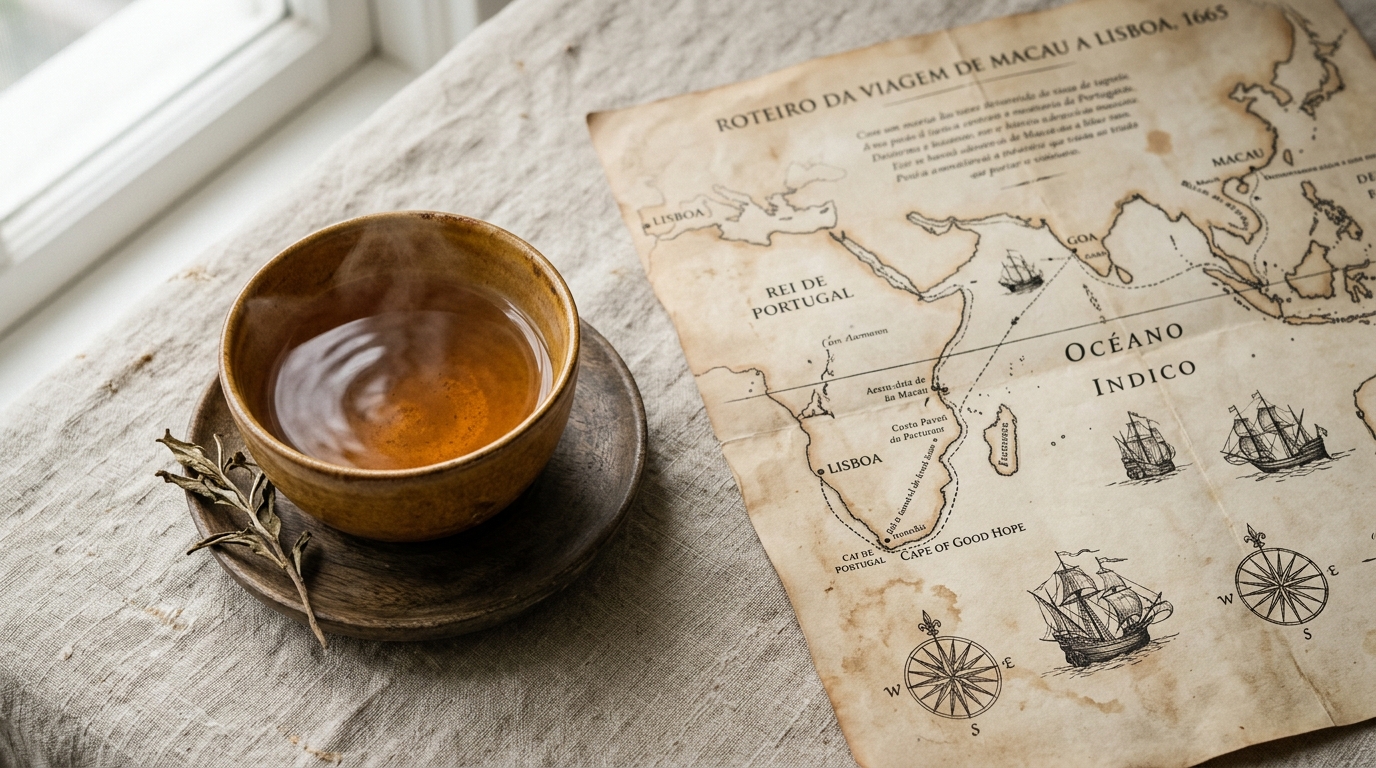
Have you ever wondered why, in almost every corner of the world, people call their favorite brew either some version of “Tea” or “Chá”?
While most of Europe went with “Tea,” Portugal stood its ground with “Chá.” As I sit here in Lisbon, watching the light hit my favorite ceramic mug, I realized that this isn’t just a linguistic quirk, it’s a story of adventure, global trade, and a very clever Portuguese woman who used tea as a social shield.
The Map of a Word: Why “Chá”?
Language usually follows the trade routes. Historically, if tea arrived by land (like the Silk Road to Turkey), it was called “Cha.” If it arrived by sea via Dutch traders from the Fujian province, it became “Tea.”
Portugal, being the first European power to establish a direct link with China through Macau, adopted the Cantonese “Chá” directly. Every time I order uma chá here in Lisbon, I’m participating in a 500-year-old linguistic tradition.
The “It Girl” of 1662: Catherine of Braganza’s Secret Strategy
We often think of “Afternoon Tea” as a quintessentially British invention. However, we actually owe it to a Portuguese princess. When Catherine of Braganza married King Charles II in 1662, she brought a chest of high-quality Chinese tea in her dowry.
But here is the juicy part: Catherine didn’t just bring tea because she liked the taste. At the time, the English court was famous for its heavy drinking and the King’s frequent “distractions” with his various mistresses.
Catherine used tea as a social tool. By introducing a sophisticated, elite tea ritual, she created a new “meeting point” that demanded sobriety, etiquette, and her own presence. It was a brilliant way to pull the King away from the chaotic party scene and place him at a table where she set the rules. She was the original “Nano-Influencer,” using a simple ritual to bring order to a chaotic world.
Small Sips, Slow Moments (Nano-Living Tip)
In the spirit of Slow Living, tea is the ultimate anchor. Unlike the frantic energy of a quick espresso, tea demands patience. You have to wait for the water to boil, for the leaves to steep, and for the heat to subside.
Just like Catherine used the tea ceremony to calm the storm of the royal court, we can use it to calm the noise of our modern lives.
-
The Ritual: Choose one mug that feels right in your hands.
-
The Sensory Experience: Notice the steam, the changing color of the water, and the scent of the herbs.
-
The Pause: Don’t scroll while you drink. Just watch the world go by for five minutes.
Modern Discovery: Europe’s Only Tea Garden
If you are visiting or living in Portugal, you don’t have to look as far as China for quality. The Azores islands (São Miguel) are home to the only industrial tea plantations in Europe. It’s a beautiful reminder that we can find extraordinary, slow-crafted treasures right in our own backyard.



Leave a Reply