
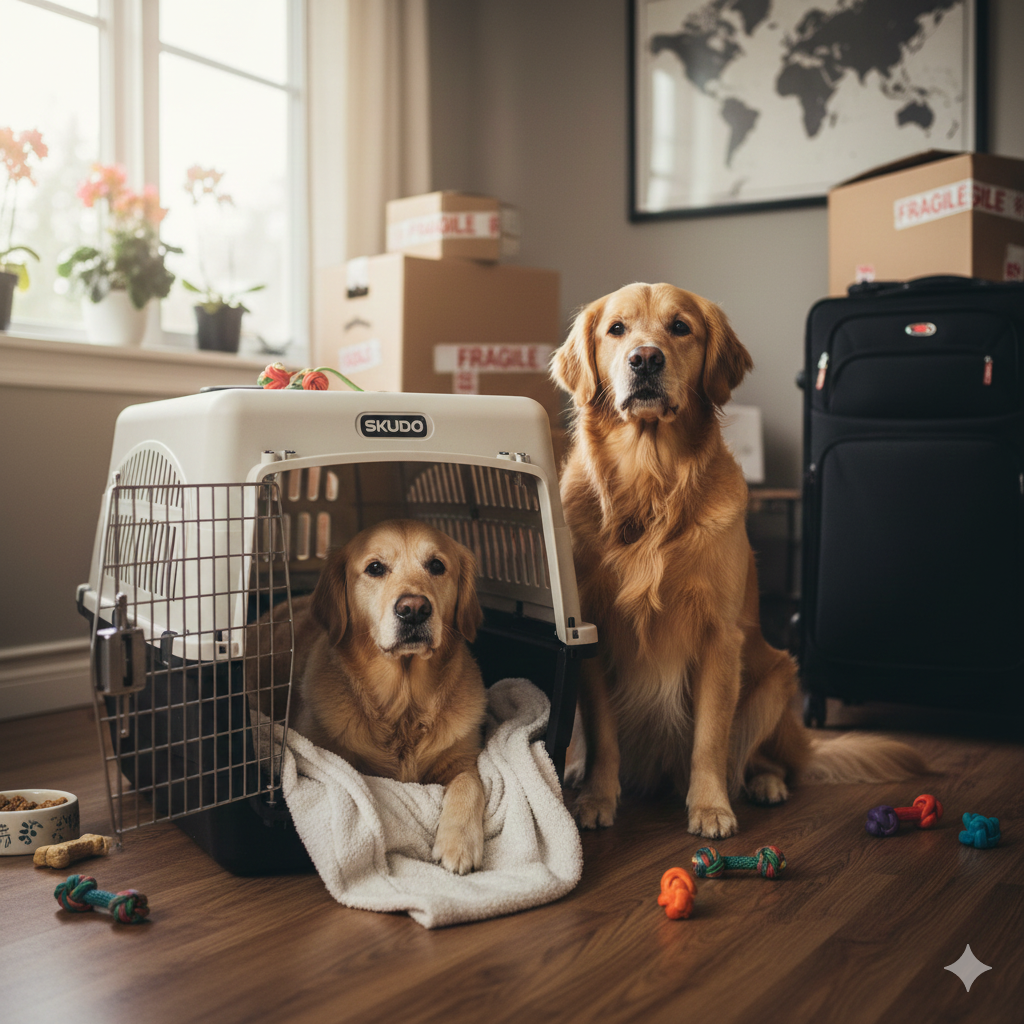
Preparing Our Dogs for the Journey: How We Used a Skudo Crate to Make Moving Less Scary
Moving to another country is overwhelming , not just for us, but especially for our dogs.
They don’t understand visas, timelines, or why suitcases suddenly appear in the living room.
All they know is that something is changing.
When we decided to move to Portugal, one of our biggest concerns wasn’t paperwork or logistics , it was how to prepare our dogs emotionally and psychologically for the journey ahead, especially the flight.
This is the story of how we introduced a Skudo travel crate and turned it from a scary object into a safe space.

Why Preparation Is More Than Just a Crate
If you are moving to Portugal with dogs from Turkey, preparing them psychologically for the flight is just as important as the paperwork.
Preparing Our Dogs for Change Before They Know What’s Coming
We share the full process, documents, and real-life challenges in our complete guide on moving to Portugal with pets from Turkey.
## Preparing Dogs for a Flight When Moving to Portugal From Turkey
For dogs, travel isn’t just physical , it’s deeply emotional.
A flight means:
-
unfamiliar sounds
-
strange smells
-
separation from their humans
-
loss of control
Putting a dog into a crate without preparation can feel like confinement.
But introducing the crate slowly and intentionally can completely change how they experience travel.
Our goal wasn’t just “getting them into the crate.”
Our goal was helping them feel safe.

Moving to Lisbon With Our Dogs: A Real Expat Guide From Turkey
Why We Chose a Skudo Crate
We chose a Skudo crate because:
-
it meets airline and IATA requirements
-
it’s sturdy and well-ventilated
-
it feels enclosed but not claustrophobic
But even the best crate means nothing if your dog associates it with fear.
So we decided the crate would never be a punishment, only a neutral or positive place.
Step 1: Introducing the Crate Without Pressure
The first rule we followed was simple:
The crate stays open. Always.
For the first few days:
-
we placed the Skudo crate in the living room
-
no door closed
-
no commands
-
no forcing
We let the dogs:
-
sniff it
-
walk around it
-
completely ignore it if they wanted
At this stage, the crate wasn’t “for travel.”
It was just another object in the house.

Step 2: Turning the Crate Into a Familiar Space
Once the crate stopped being “new,” we made it familiar.
We added:
-
their favorite blanket
-
a piece of clothing that smelled like us
-
familiar toys
Smell is everything for dogs.
The moment the crate smelled like home, their body language changed.
They were no longer suspicious , just curious.
Step 3: Positive Associations (Without Overdoing It)
We avoided dramatic training sessions.
Instead:
-
treats appeared near the crate
-
later, treats appeared inside the crate
-
meals were occasionally served next to it
We never pushed them in.
When one of our dogs stepped inside on their own, we didn’t celebrate loudly.
We stayed calm.
Because calm = safety.

Step 4: Very Short, Calm Door Closures
Only after several days did we gently close the door.
At first:
-
just a few seconds
-
we stayed right there
-
door opened before any stress signals
Then slowly:
-
a minute
-
two minutes
-
door closed while we sat nearby
We watched for:
-
heavy panting
-
whining
-
stiff posture
If we saw stress, we stopped and went back a step.
Progress isn’t linear and that’s okay.
Step 5: Preparing Them Emotionally for Separation
One of the hardest parts of flying with pets is temporary separation.
To prepare for this:
-
we practiced short separations at home
-
crate time without constant eye contact
-
leaving the room briefly, then returning
The message we wanted to send was:
“We always come back.”
That trust matters more than any command.

Understanding the Psychology Behind It All
Dogs don’t fear the crate itself.
They fear loss of control and unpredictability.
By:
-
letting them choose
-
keeping routines stable
-
staying emotionally neutral
we gave them back a sense of control.
The crate became:
-
a boundary, not a prison
-
a pause, not a punishment
-
a safe bubble in a changing world
The Most Important Lesson We Learned
You can’t rush emotional preparation.
Documents can be completed in a checklist.
Trust cannot.
Preparing dogs for international travel isn’t about perfection , it’s about patience, observation, and empathy.
Our dogs may not understand why we’re moving to Portugal.
But they understand this:
They are safe.
They are not being abandoned.
And they are not facing this change alone.
While this guide focuses on dogs, many of the same emotional preparation steps apply when moving to Portugal with pets from Turkey.

Final Thoughts for Anyone Moving With Pets
If you’re preparing your pets for a big move:
-
start earlier than you think
-
go slower than you planned
-
and listen more than you lead
A crate can be a source of fear,
or it can become a familiar place when everything else changes.
You get to decide which one it will be.
## Frequently Asked Questions About Flying With Dogs From Turkey to Portugal
**How early should dogs be introduced to a travel crate before a flight?**
Ideally 3–6 weeks before flying, allowing enough time for psychological adaptation.
**Is Turkey considered a non-EU country for pet travel to Portugal?**
Yes. Pets traveling from Turkey must follow non-EU import rules.
**Are Skudo crates accepted by airlines flying to Portugal?**
Yes, Skudo crates meet IATA requirements used by most airlines.




Leave a Reply